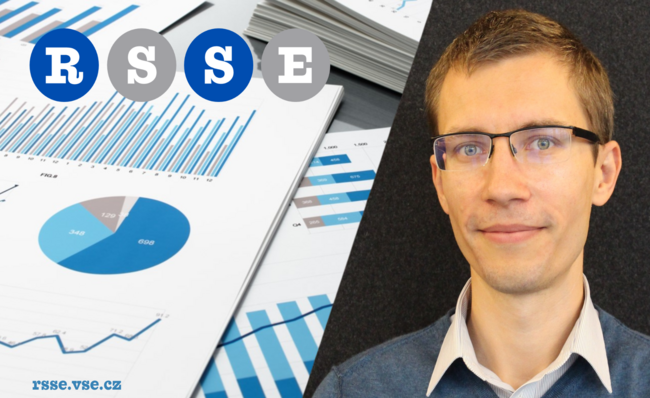
Michal Burzynski (Luxembourg Institute of Socio-Economic Research) 3.12.2026
It is our pleasure that Michal Burzynski (Luxembourg Institute of Socio-Economic Research) will present on Thursday, December 3, 2026, at 12:45 in room RB437 about the topic “The Labor Market Impact of Immigration in Europe: Sorting, Self-Selection, and Inequality”.
Registration is not required and anyone who would like to attend is warmly invited.
It is also possible to participate online via MS Teams at this link. In case of any connection issues, please contact lubomir.cingl@vse.cz.
ABSTRACT: This paper revisits the wage and inequality effects of immigration through a novel multidimensional Gaussian Roy model. Solved for an arbitrary number of dimensions and embedded in a spatial general equilibrium framework, the model quantifies the consequences of non-European immigration for European native workers. Although the aggregate effects are predominantly positive, I decompose them into their underlying channels and provide a granular analysis across regions, occupations, and within continuous wage distributions. Immigration-induced occupational sorting among natives, mainly due to job upgrading, emerges as a non-negligible mechanism through which natives gain, especially from less-skilled immigration. The self-selection of job switchers partly offsets these gains in the aggregate, yet generates differentiated within-cell effects spanning the entire wage distribution. Consequently, the inequality effects of immigration are richer and more heterogeneous across channels than state-of-the-art labor market models suggest.
BIO: Michał Burzyński is a researcher at the Luxembourg Institute of Socio-Economic Research (LISER), based in Esch-sur-Alzette, where he has worked in the Labor Market Department since September 2018. He describes himself as a quantitative theorist in international and labor economics, with research interests spanning the economics of international migration, quantitative economic theory, international economics, and general equilibrium modelling. He earned his Ph.D. in economics and completed part of his academic training at the Université catholique de Louvain and Poznan University of Economics. Much of his work uses macroeconomic models with microeconomic foundations to quantify how international migration affects growth, inequality, and welfare in both sending and receiving countries, examining questions of migrant self-selection, labor market sorting, and displacement effects. He is the principal developer of the CliC:ME model (see: clicme.liser.lu) and has been the principal investigator of the Labor Market Mobility: Immigration, Automation, and Inequality (LaMaM) project funded by Luxembourg’s Fonds National de la Recherche. More recently, his research has extended to the socio-economic impacts of climate change on human mobility, including work presented in connection with climate mobility initiatives in the Caribbean and at COP30. His research has appeared in journals such as the JEEA, JIE, JDE, and the IMF Economic Review.